How Form Informs Content: Barbara Langhorst’s “Climate Change” from Restless White Fields

The phrase “climate change” refers most obviously to global warming, the melting of polar ice caps, the erosion of the ozone layer, the impact of human industry on the environment. It makes sense to title a poem about catastrophe “Climate Change,” and Barbara Langhorst does not disappoint, though the environment is the family, and the catastrophe is the problem of motherhood.
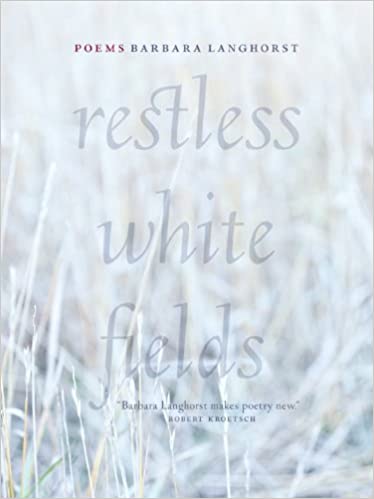
“Climate Change” opens with the speaker addressing her daughter, then parallels her self-perceived failings as a mother to her own “radiant” mother (27). The parallel is quite literal—the past and present exist simultaneously on the page, with the speaker’s present on the left and her memory on the right, curving outwards and foreshadowing the later shapes and melding of present and memory into grief. 

On the following page, these two parallels are brought together through an italicised stanza that describes and enacts what the speaker is doing: reading. The italics indicate quotations from other written works (citations located at the back of Langhorst’s book), so that the poem shows us what the speaker reads even as she writes the poem. The tension between memory and the speaker distracting herself through reading is realized with the mention of “at her funeral,” when the reader sees that the memory of summer lake visits is overwhelmed by the presence of mosquitos at the mother’s funeral (28). The reluctance to face this other memory—or the desire to hold onto the happier memories—is indicated through word-spacing. A small stanza on the left could read “the last day / the inevitable / soggy three-day / holiday week / end—” and be talking about the speaker’s desire to remain at the lake as a child, or the desire to remain inside that memory (28). However, the lines “[the mosquitos overwhelming / at her funeral]” interrupt this stanza, claim space beside the end lines, so that the end of the holiday weekend becomes the funeral weekend (28). The square brackets around those lines further indicate the intrusion of thoughts the speaker would rather keep at bay. The poem then focuses on describing the mother as she was, but this is overrun by the mention of the speaker’s father, and the poem abruptly reverts to quoted lines; the speaker turns off her thoughts by returning to reading.

However, the thoughts return and the speaker soon tells us—hesitantly, haltingly, with many interruptions from other texts—that her mother was murdered, and that “three days the bodies lay,” with no other hint of her father (29). The following page retreats into quotes and memory, with the speaker berating herself and her family for forgetting their mother’s birthday, and the accompanying quotes relaying a mother-daughter experience that could have been shared by the speaker and her own mother (30). The layout of this page positions the speaker’s memory inside a cocoon of borrowed memories (quotes) that insulate the speaker’s regret. This regret is tied to how her mother died, and that it took so long to discover her death, but ensconced inside the mundane quotation-memories, this specific instance of disappointment speaks to the larger regret without facing it head-on.

Conversely, the next page is displayed in a circle, with quotes and the speaker’s thoughts interspersed together and a void left in the middle of the page (31). On this page, the poem can be read as italics, then non-italics, across the lines, or down either side and then the next, or even jumping between stanzas, so that the eye crosses over at each extra space between lines. The lack of direction in how to read this embodies the lack of direction experienced by the speaker, regarding both processing her grief and reconciling her ‘failures’ as a mother with her ‘failures’ as a daughter. The circle implies the cyclical nature of grief and trauma, while existing as a gaping hole, but the poem leads out of this in a descending line that continues straight down the page, offering a path out of grief and depression, while still allowing for that grief to be revisited and explored from other angles upon (re)readings.

While the end of the poem tells the reader that the speaker’s father is responsible for her mother’s murder, and that afterwards he killed himself too, the poem refuses to be defeated. The end circles back to the beginning, and returns to food and notions of nutrition, allowing room for her family climate to change again, for the better, while recognizing that that change has not occurred by the end of the poem.


Work Cited

Langhorst, Barbara. Restless White Fields. NeWest Press, 2012.

Essay by Allie McFarland, a bi, white settler originally from Calgary, AB on Treaty 7 territory. She holds an MFA in Writing from the University of Saskatchewan’s Department of English, where her thesis, a manuscript on eating disorders currently under consideration with multiple presses, was nominated for the College of Arts & Sciences Thesis Award. She is a co-founding editor of The Anti-Languorous Project, which publishes antilang. magazine, soundbite, Good Short Reviews, and the On Editing blog series. Her poetic suite “Lullaby” won the 2015 Dr. MacEwan Literary Arts Scholarship. She is also the author of the chapbook Marianne’s Daughters (Loft on EIGHTH, 2018). Allie currently runs a not-for-profit used bookstore on the unceded territories of the Lekwungen people of Vancouver Island. Disappearing in Reverse is her full-length debut.
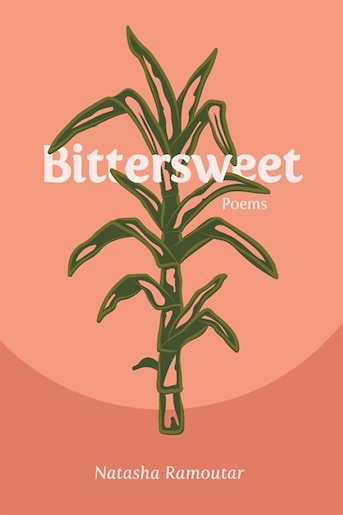
Reconstructed Homeland: A Review of Bittersweet by Natasha Ramoutar

Please note: Quotes are formatted as closely as possible to the original text. There may be some discrepancies. 

Natasha Ramoutar’s debut poetry collection, Bittersweet (2020), reflects on a “reconstructed homeland” of the Indo-Guyanese diaspora and Scarborough, Ontario (Cover copy). Playful, inventive, and poignant, the artfully titled Bittersweet asserts poetic creation as a tool to explore the persistent aftertaste of racism, colonialism, and the self, while asking: “How do you unravel a history of trauma, that which is woven / within you?” (Ramoutar 72). 

In answering this question, Ramoutar is like a cartographer, drawing maps from “home to home, from Toronto to Guyana to South Asia” (Cover copy). Meanwhile, Scarborough remains omnipresent as a “city of travellers” (32) within which Ramoutar weighs her life against history, like tea leaves, shifting “back and forth, / reading for the past instead of the future” (5):

Ask me where I come from and I will tell you: from the remnants of melted sugar cubes, from the rough grains ripped from stalks, from spices and saccharine scents, from a sweetness that mixes with cardamom hanging in the air. I come from a line of bittersweet women, women shrewd enough to empty pockets, to upturn kingdoms, to launch ships to war. On a journey long ago, I witnessed the origin point: fields of cane standing tall like soldiers on patrol. But cane is raw, just long stalks, unbridled and wild and free. (2)

What is striking in this poem, “Cartography I,” is the associative imagery between “remnants of melted sugar” and women. Both are “rough grains ripped from stalks,” reduced from “fields of cane standing tall like soldiers” to something bittersweet (2); pleasure tinged with suffering. This layering effect underscores Bittersweet as Ramoutar returns to different “origin points” to collect pieces of her homeland and explore her third-culture identity (2).

The back cover states that when writing Bittersweet, Ramoutar meditated on “memory—[personal and collective]—prompted by photographs, maps, language, and folklore.” The collection draws from these sources to evoke metaphor and renovate form. For instance, “All Inclusive” mimics an advertisement for an all-inclusive vacation package (34). The poem parallels “white-sand beaches, / places we can dub nirvana” with colonialism: “six days of escaping, / six days of imposing” (34). Ramoutar’s inventiveness with form, such as creating an all-inclusive vacation, a fire-starting guide (9), and recipe (67), subverts the positive multi-cultural identity of Scarborough, revealing it as problematic. She does this by taking familiar markers in western culture and defamiliarizing them to show their harmful nature. Most importantly, Ramoutar confronts readers from outside the Indo-Guyanese community with challenging subject matter, asking them to reflect inward and create something positive in the process. 

Whether it raises awareness of systemic racism or begins unravelling readers’ relationship with trauma, Bittersweet has something for everyone. While the audience for some poems is primarily those outside the Indo-Guyanese community, others speak directly to “diaspora babies” (13) who “walk on eggshells” (69) and are made to suppress their identities: “never add your own flavours. They’re not a good fit” (67). These poems share stories of resilience in marginalized communities by celebrating the parts of language, dance, cuisine, and history that are retained and reclaimed. These bits of collected memory blend with a constant yearning to know a home that was stolen, as exemplified in “Us Diaspora Babies, We Do Not Sleep”:

This boat, it rocks back and forth like a cradle on the Essequibo 

            River,

us diaspora babies swathed in red life jackets,

the steady shifting trying to lull us to dream.

[…]

This boat tries to comfort,

but us diaspora babies,

we do not sleep —

only dream with eyes wide open, 

grasping at the water of our homelands, 

droplets slipping through our fingers with each midsummer 

            breeze.

Us diaspora daughters, 

listening to our parents’ stories of the golden era 

of a far off youth.

We know of home through photographs and UN reports, 

but what of seeing with our own eyes?

What of divided states of being?

What of us diaspora babies, 

Us diaspora daughters,

exiled before birth? (13)

Bittersweet by Natasha Ramoutar is a “sugary syrup” (61) of sensory details with an aftertaste of racism and colonial violence. The poetics are clever, the form and content engaging, but the real reason to read Bittersweet is that it validates Indo-Guyanese diasporic experiences as being as true and important as any other. As Ramoutar unravels internalized trauma and explores her identity, readers are invited into a space where they can safely do the same. One must read the collection to reach Ramoutar’s conclusions, but rest assured, “it comes together / slowly” (72).

Works Cited

Ramoutar, Natasha. Bittersweet. Mawenzi House Publishers Ltd., 2020. 

Cover copy. Ramoutar, Natasha. Bittersweet. Mawenzi House Publishers Ltd., 2020.

Review by Aliza Prodaniuk. Aliza graduated from McMaster University with an honours BA in English and Cultural Studies. She secretly enjoys sci-fi and fantasy but will tell you she only reads literary fiction. She is currently creating and exploring in Dundas, Ontario, where her work dabbles in murder mystery, eco-fiction, and realistic fiction. Her writing has been published in various business, science and travel magazines/journals, with her most recent work appearing in the Canadian Journal for Medical Laboratory Sciences. She’s currently happy to have time to focus on her work while learning alongside other writers at the U of S. 

Interview with Lenard Monkman

Özten Shebahkeget Interviews Lenard Monkman

Lenard Monkman, writer and associate producer with CBC Indigenous

Özten Shebahkeget: When did you begin to take writing seriously? And what motivated you to start?

Lenard Monkman: I didn’t take writing seriously until around March of 2015. I set it as one of my goals that year to become a better writer. That month, I started a personal blog just to get used to having a space for my writing, but also just to get into the habit of writing all of the time. Another thing that I started doing was putting out long Facebook statuses. I wanted to get into the habit of writing every day and getting used to having feedback from my online Facebook community. It was a good practice for me, and those long-winded Facebook statuses eventually became newspaper op-eds, which eventually became a job as a journalist. Truth is, I have always been a journalism nerd, I just needed to get used to writing every single day.

ÖS: What obstacles have you encountered as a writer? 

LM: If you take it from 2015, I would say that there haven’t been too many obstacles. At the beginning of that year, I went from barely being able to write a properly formatted email and typing very slowly, to being able to write 500 words in 5 minutes by August. Although now, when I look at the things that I was writing five years ago, it is hard to read because I can see how much I have improved since then. The best advice that I ever got from anyone was: if you want to become a writer then you need to pen to paper every day. I always thought about that and recognized that every single time that I write, it’s an opportunity to improve with each story and each sentence.

ÖS: You are a co-founder of Red Rising Magazine. Why was creating a literary magazine for and by Indigenous people important to you? 

LM: I wanted to get into producing media before we started Red Rising Magazine. It was definitely a collective effort to get it off the ground with a bunch of energetic, intelligent folks from Winnipeg. We went from not having a whole bunch of skills, to having all sorts of publishing related skills in just the first year. I think the main idea behind everything that we did was to give Indigenous writers and artists an unfiltered platform that existed outside of the traditional forms of media. The magazine became a place where many people that I know had their first opportunity to be published and it is something that I am proud of. Although I haven’t been with the collective for a couple of years now, I still believe there is a space for that type of work and would like to see it continue in one form or another.

ÖS: You have been a journalist with CBC since 2016. The Canadian media has always had such a profound impact in framing Indigenous stories, and storytelling is an integral aspect of Indigenous cultures. What do you feel are your responsibilities as an Indigenous journalist, and what have you learned from telling the stories of a vast array of Indigenous peoples in Canada?

LM: I think the biggest responsibility is to make sure that what I am doing is truthful and that people feel like they were accurately represented in the work that I have done. I haven’t done as much “accountability” type of journalism as much as I have done the “here are some Native people doing really cool things” type of journalism. I really want to use the mainstream media platform to try and boost our people’s presence and to highlight their successes. But I also strive to make sure that the reality of what our people go through is being heard in newsrooms like the CBC. What I have learned from talking to so many Indigenous peoples across the country over the years is that we are brilliant and that our cultures are diverse. I’ve also come to realize that so many of our struggles are similar from coast to coast. There are a lot of things that I continue to learn as the years go by, but getting a chance to talk to Indigenous people all over the country is easily the most enjoyable thing about my job.

ÖS: What are some of the books that have influenced you? 

LM: I always give credit to Indians Wear Red. The book spoke to my reality of what it was like growing up in Winnipeg’s inner-city in the 90’s-00’s. It really was a “light bulb moment” for me to understand that what I was seeing in my life was happening not just in my life, but everyone else in my community as well. The last chapter “What Can Be Done?” was also a call to action for me. I think that the more we are able to try and create changes within our communities, the less healing the next generation will have to do. Another book that I really like is Franz Fanon’s Black Skin, White Masks. There are a lot of really good psychological gems inside that book that are applicable to the Indigenous community.

ÖS: What do you write outside of journalism?

LM: I still love Facebook more than the other apps. It allows me to joke without feeling like I’m being judged. It allows me to write in long-form if I ever need to get a thought out. I also really just practiced everything that I could in terms of writing on that app. I also like to use Twitter, although it’s more of a professional space. Twitter has made me a better writer because I put a little bit of thought into trying to make those sentences a bit stronger.

ÖS: Where would you like your writing to go next?

LM: I feel like I have been thinking about this question for a couple years now. I try to improve with each story that I write. I also try to improve with each radio script, TV script and everything else that is journalism related. I have thought for a long time about whether or not I would like to write children’s books, graphic novels, fiction or nonfiction. I guess the biggest thing that stops me is feeling like I need to be an incredible writer before I actually start writing. Eventually I will settle on a subject, and hopefully I can dedicate enough time to sit down and hammer out something that is loosely based on some of the things that I have seen in my life.

*

Lenard Monkman is Anishinaabe from Lake Manitoba First Nation, Treaty 2 territory. He has been an associate producer with CBC Indigenous since 2016. In 2021, he received the Manitowapow Award from the Manitoba Book Awards for his contributions to the Indigenous writing community.

Özten Shebahkeget is a member of Northwest Angle 33 First Nation and an MFA candidate at the University of Saskatchewan. She grew up in Winnipeg’s North End and holds a BA in English from the University of Winnipeg. Her poetry has appeared recently in CV2Prairie Fire and The Winnipeg Free Press.

Interview with Louise Halfe – Sky Dancer

Özten Shebahkeget Interviews Louise Halfe – Sky Dancer

Louise Halfe – Sky Dancer, award winning poet and Parliament’s ninth Poet Laureate

Özten Shebahkeget: What draws you to poetry as opposed to other forms? Who are some of the poets that have influenced you?

Louise Halfe: I’ve written poetry all my life and have explored other genres, but other than essay presentations the other forms have not captured my muse. So, I honor the gift I have been bestowed. I do not allow other poets to influence me, though I highly respected the late Patrick Lane and his raw honesty.

ÖS: Your latest poetry collection, awâsis – kinky and disheveled, contains a lot of shapeshifting. Did this affect the writing process for awasis at all? Does your writing process differ with each book?

LH: Yes, shapeshifter had me glued to its arrival and I had to pay attention to her/his shape as she/he settled on the page. Bear Bones and Burning In This Midnight Dream are similar in nature, The Crooked Good and Blue Marrow are both epic poems and follow a different thread. And naturally awâsis, as the character (him/herself) holds her own court.

ÖS: The use of humor is also an important facet of awâsis. Why is humor important to you and your writing?

LH: People discuss humor in their writing; however, there is a need to show rather than just talk about it. My previous work has been dark so to speak, though I myself am not at that place. Therapy is extremely useful, and I wanted to highlight the great humor people possess that is so essential to one’s survival.

ÖS: Do you consider writing a form of personal ceremony? Why or why not?

LH: Yes, it is. Spirit is very much in our bodies and it speaks through all of us. But most of the time people take it for granted that they are just human entities, and behave as such, not being mindful that we are all spiritual beings. Hence, spirit works through the body – fingers, heart- emotional intelligence, mind – the rational being.

ÖS: What would you like readers to take from your writing?

LH: I wish that people learn to dialogue with one another across cultures and their so-called class privileges. We’ve only one life and there isn’t time to waste it being racists – which is a form of low self-esteem. This low self-esteem is really a need to feel superior.

ÖS: Are there art forms outside of literature that influence you? What are they?

LH: I’m not influenced per se, but I can travel with their images as in painting and go on a wayward journey. I can watch a dance and create my own interpretation. I can listen to music, whatever it is: jazz, symphony, orchestra, country, and allow my emotions and have free flowing thoughts.

ÖS: Where do you want to go next, with writing and with life?

LH: Where-ever the spirit takes me, and it insists I will listen and discern.

*

Louise Bernice Halfe – Sky Dancer was raised on Saddle Lake Reserve and attended Blue Quills Residential School. Her first book, Bear Bones & Feathers (Coteau, 1994), received the Milton Acorn People’s Poetry Award and was a finalist for the Spirit of Saskatchewan Award, the Pat Lowther Award, and the Gerald Lampert Award. Blue Marrow (Coteau, 1998) was a finalist for the 1998 Governor General’s Award for Poetry, and her fourth book, Burning in This Midnight Dream (Coteau, 2016), won the 2017 Saskatchewan Book Award and the Raymond Souster Award, among numerous other awards. Her newest book is awâsis – kinky and dishevelled (Brick Books, 2021). Brick Books is publishing a new edition of Burning in This Midnight Dream in May 2021. Halfe was awarded the Latner Writers Trust Award for her body of work in 2017, and was awarded the 2020 Kloppenburg Award for Literary Excellence. She was granted a lifetime membership in the League of Canadian Poets, and currently works with Elders in the organization Opikinawasowin (“raising our children”) and lives near Saskatoon with her husband, Peter.

Özten Shebahkeget is a member of Northwest Angle 33 First Nation and an MFA candidate at the University of Saskatchewan. She grew up in Winnipeg’s North End and holds a BA in English from the University of Winnipeg. Her poetry has appeared recently in CV2Prairie Fire and The Winnipeg Free Press.

Interview with Waubgeshig Rice

Özten Shebahkeget Interviews Waubgeshig Rice

Waubgeshig Rice, author of Moon of the Crusted Snow and journalist from Wasauksing First Nation.

Özten Shebahkeget: What are you currently reading, and what are some of the books that have influenced you?

Waubgeshig Rice: I recently started a podcast with my friend Jennifer David called “Storykeepers” that focuses on literature by Indigenous authors, so I’m doing a lot of reading and re-reading for that. Our next episode features Split Tooth by Tanya Tagaq, so I’m giving that another look. Otherwise, I’m chipping away at a re-read of Stephen King’s The Stand just for fun. As for the books that have influenced me, there are so many, but if I was to highlight the books I read as a teenager that changed my life, I have to mention Keeper n’ Me by Richard Wagamese, Tracks by Louise Erdrich, Green Grass Running Water by Thomas King, The Lesser Blessed by Richard Van Camp, and Ravensong by Lee Maracle. There are so many more, too!

ÖS: What does your writing routine look like?

WR: It’s been pretty varied due to the pandemic and how it’s affected our life at home. For most of the school year, our older son was in class physically. So I’d take him to school, and then write for the rest of the morning, take a break for lunch, and then write in the afternoon until he was home. But for our most recent lockdown in Ontario, schools here in Sudbury went online in March, so he’s been at home since and I’ve been helping him with his schooling. So I moved most of my writing to the evening when both of our kids (we have a one-year-old son as well) were in bed. I’ve always tried to be adaptable and flexible with my writing routine, and the pandemic has been a good test of that!

ÖS: You were a journalist for a number of years with CBC before moving on to fiction. What do you feel are your responsibilities as a writer? Do they change as you hop genres?

WR: I feel my responsibilities first and foremost are to the people who share stories with me, and to the cultures and communities they come from. When I worked as a journalist, I always saw myself simply as a conduit for the real-life experiences of others. I was there to help them share their stories with wider audiences. And now that I work primarily as an author of fiction, a lot of the stories are inspired, influenced, and informed by my Anishinaabe heritage and community. So my responsibility is to my people, if I’m going to write about Anishinaabe experience in fiction. That means respecting culture and history, and sharing stories in a respectful and meaningful way. I need to be aware of my limited perspective, and the permissions around sharing certain details, specifically about culture. For me, I don’t think those responsibilities change much as I move across genres and formats. I always have to be accountable to the communities I inhabit and participate in, because they’re what influence just about everything I write.

ÖS: You’re currently working on the sequel to your novel, Moon of the Crusted Snow. How has the writing process been compared to MCS?

WR: I wrote Moon of the Crusted Snow while I was working as a full-time TV reporter for CBC in Ottawa, so most of that writing happened in the early mornings, evenings and on weekends. It was basically a spring to get as much written as possible in those short windows! I was fortunately able to take a couple leaves of absence for a couple months at a time to really finish it up. But that process was entirely different from my current work on the sequel. My family and I now live in Sudbury, and I left my job at CBC here in May of last year to focus primarily on my career as an author. That’s really when the heavy lifting for the next part of the story began. I was able to spend my daytime hours developing and researching the story, and I’ve never really had that full-time opportunity before. It definitely hasn’t felt like a frantic or rushed process. It’s been nice to be able to take my time and let the story unfold naturally. After spending most of the rest of last year dreaming up and plotting out the story, I started writing out the manuscript. I just finished the first draft, and I’m excited to begin the revision process.

ÖS: What drew you to apocalyptic fiction?

WR: Initially it was reading classic books in the genre back when I was in high school. In Grade 12 English class we read Brave New WorldFahrenheit 4511984, and more. I was really drawn to the speculative imaginings of life after the end of our current world. I saw those stories as commentary on the flaws and detriments of our current society, and just how bad things can get if we don’t live in a good way. But also around the same time, I had a conversation with my grandmother on the rez about how Anishinaabeg (and all Indigenous people) have already survived the end of the world. She reminded me about our people’s history on the shores of Georgian Bay and how our ancestors were displaced from our homelands, which were then exploited for capitalism. It’s a perspective and knowledge of history that really reminded me of the resilience of Indigenous people, and how our modern stories are all basically post-apocalyptic. That really inspired me to try to capture that experience in literature, which a lot of other Indigenous authors like Louise Erdrich and Cherie Dimaline have done expertly.

ÖS: Do you pre-plan your writing? Or do you write by the seat of your pants?

WR: I pre-plan almost everything! I always write a story outline and character profiles before I write the actual manuscript. I also make pretty detailed notes of some of the elements I want to include in the story, no matter how minor or seemingly mundane. That all helps me build the world the characters inhabit before jumping in to explore it myself as the writer of the story. I write a lot of the imagery that I imagine in my head, so I sometimes create visual references too, whether that’s taking photos on my own, or finding images and representations of what I want to write about online. Even though I do a lot of meticulous planning, I still approach the actual writing process with a pretty open mind. I let the story do what it needs to, even if it deviates from some of that original planning. I think writers really have to be flexible and allow stories to unfold organically. In that sense, all that pre-planning can be a good foundation or guideline. All that to say, it’s important to remember to have fun! 

ÖS: Who do you write for besides yourself? And what do you want readers to take from your work?

WR: I write for anyone who wants to read. I just want to create a compelling story that a reader can connect with. All I want them to take from my work is that it comes from a writer who is trying to do their best, who stays true to themselves and their background. It’s important for me to be as genuine and candid as possible in my writing, and I hope that comes through. I also hope they learn something, and that my writing potentially opens their eyes to new experiences or stories, regardless of their cultural background.

ÖS: Where would you like your writing to go next?

WR: Well, after spending so much time in recent years working on post-apocalyptic and dystopian settings, I would like to write something a little lighter! I have some ideas for funnier stories I’d like to explore. We’ll see how that goes once I’m done with all the revisions to the sequel of Moon of the Crusted Snow. I’d also like to gain more experience with screenwriting. It seems like a wide and exciting world with a lot of potential for interesting storytelling. But at the end of the day, I’m just really thankful for any writing opportunity that I have. I’m very fortunate to have ended up on this path. It’s a dream come true!

*

Waubgeshig Rice is an author and journalist from Wasauksing First Nation. He has written three fiction titles, and his short stories and essays have been published in numerous anthologies. His most recent novel, Moon of the Crusted Snow, was published in 2018 and became a national bestseller. He graduated from Ryerson University’s journalism program in 2002, and spent most of his journalism career with the Canadian Broadcasting Corporation as a video journalist and radio host. He left CBC in 2020 to focus on his literary career. He lives in Sudbury, Ontario with his wife and two sons.

Özten Shebahkeget is a member of Northwest Angle 33 First Nation and an MFA candidate at the University of Saskatchewan. She grew up in Winnipeg’s North End and holds a BA in English from the University of Winnipeg. Her poetry has appeared recently in CV2Prairie Fire and The Winnipeg Free Press.

Capturing the Magic in Honey

*A note on the text: due to constrictions of WordPress, the excerpts from the text may not be formatted as they appear in the text. We did our best to format excerpts as close to the original as possible.

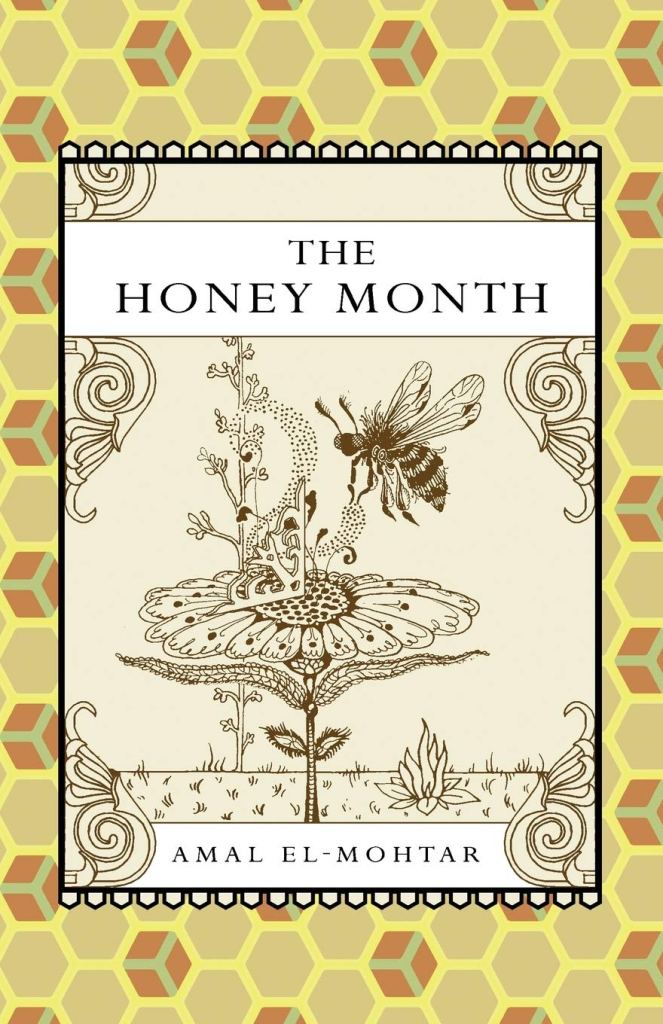
Honey. That viscous, golden-amber liquid produced by bees has been praised for centuries for its delicious taste as well as its medicinal (and sometimes magical) qualities. Many ancient cultures considered honey and milk acceptable gifts to the gods. It comes as no surprise then, that the poems and short prose in Amal El-Mohtar’s The Honey Month (2010) draw upon the sensuous and mythical qualities associated with the golden nectar.

Amal El-Mohtar’s The Honey Month

The Honey Month had its beginnings in a set of twenty-eight different types of honeys that had been given to El-Mohtar as a gift by a friend.  Inspired by this collection of exotic honeys, she set out writing poems or pieces of prose for each flavour of honey she tasted in the following month, preceded by short sections of sensory notes describing the smell, taste, and colour of each sample. Written in a journal-like format, each day has a new entry of honey-inspired poetry or prose to whet your sweet tooth. The pieces in this collection are dripping with language that excite the senses and expand on the sensory notes given at the beginning of each entry. They also pay homage to the mythical history of honey by telling tales of daring, lonely, and not-altogether-human women and the enchanted worlds they inhabit. El-Mohtar mixes honey with fairy-tale worlds so well that honey itself takes on magical qualities, as seen in “Raspberry Creamed Honey”:

‘Where, if you’ll pardon my asking,’ I cleared my throat slightly, ‘is the dawn?’

‘Being swallowed by the ogress,’ murmured the river. ‘She’s pulled it from me like a tablecloth, and I am bare and cold when I should be warm.’

‘Why now? The dawn has risen for every day of the ogress’ long life; why should she fancy a taste for it now?’

‘Why not?’ shrugged the river. ‘She’s an ogress; you’ll find they’re always hungry. Perhaps she ran out of raspberry creamed honey and thought the dawn an appropriate substitute.’ (31)

The poems and prose are laced with magic, injecting the otherworldly into their lines. The dream-like mood of these pieces transports the reader into new and intriguing worlds, while the sensory language helps ground them in real smells, sights, and tastes. The book itself is a work of art, with beautiful illustrations interspersed among the entries. The images reflect the written poems and prose in bewitching washes of vibrant colour that are as pleasing to the eye as El-Mohtar’s words are to the mind.

With Rhysling Awards for Best Short Poem in 2009, 2011, and 2014 under her belt, El-Mohtar’s skill as a poet is well recognized. In fact, the poem that won the 2011 award, “Peach Creamed Honey,” is in The Honey Month. Anyone who has read El-Mohtar’s other poetry will be familiar with the speculative lens through which she frequently writes, and this collection is no exception. The book oozes with magic, mystery, and intrigue and will leave you guessing at what has truly taken place at the end of each work of prose and poetry.

The tone of El-Mohtar’s magical pieces oscillate between whimsical and coy and something far more oblique and dangerous. The more cheerful poems and short fiction use the motif of honey and sweetness to emphasize pleasure. In “Peach Creamed Honey,” the poem is lighthearted, a tale of playful young lovers under the summer heat:

I’ll see her lick her lips, and I’ll see her bite a frown,

and I’ll see how she’ll hesitate, look from me up to the town

and back, and she’ll swallow, and she’ll say: ‘can I try?’

and I’ll offer like a gentleman, won’t even hold her eye.

Because she’ll have to close them, see. She’ll have to moan a bit.

and it’s when she isn’t looking

when she’s sighing fit to cry,

that I’ll lick the loving from her,

that I’ll taste the peaches on her

that I’ll drink the honey from her

suck the sweet of her surprise. (17)

Other pieces hint at the darker side of these charmed, magical worlds. Often, these depict the destruction of a naïve or lonely young woman who ignores her gut feelings or the advice of others, and ultimately meets their end. In such works, honey is like bait in a trap, luring girls in with surface-level beauty or pleasure before they finally succumb to hidden danger. These are cautionary tales about the magical intoxication these honeys can bring. “Lemon Creamed Honey” is one of these bleaker tales:

The lemon road is long, the lemon road is wide,

The lemon road is pleasant maid-sung song;

The lemon road will have you for its bride.

When first I ventured my feet from the salt-stitched tide,

They told me I was foolish, told me I was wrong.

‘The lemon road is long, the lemon road is wide,

It will sour all your footsteps, sour you inside.

Stay here with the brine, with us, where you belong—

the lemon road will have you for its bride.’

I laughed at their warnings, but I couldn’t—though I tried—

put them from my thoughts while I walked myself along.

The lemon road is wide, the lemon road is wide,

and I felt myself pucker, felt a tightness in my side,

a frown on my lips, with the whisper growing strong:

the lemon road will have you for its bride. (25)

Whether it’s for the magic, delicious language, or beautiful layout, The Honey Month is the perfect book for anyone who likes a bit of magic and honey in their lives. This wide array of honey-inspired stories offers something different with each entry. It’s almost guaranteed that you won’t be bored, as Amal El-Mohtar is a master of sensory language and enchanting poetry and prose reminiscent of fairy tales. Read it like a sampling and enjoy your own honey month.

Work Cited

El-Mohtar, Amal. The Honey Month. Papaveria Press, 2010.

Review by Amanda Dawson. Amanda grew up in rural Alberta, Canada, where she spent her time reading books, stargazing, and searching for a door to the Faerie realm in the forest near her house. She is currently pursuing a MFA in Writing at the University of Saskatchewan.

Shapeshifting Realities in Louise Halfe’s awâsis – kinky and disheveled

The painting on the cover of Louise Halfe’s latest poetry collection, awâsis – kinky and disheveled, is jarring at first glance: An Indigenous person with electrifying hair, a fox’s tail, one muscular arm draped with white fur and a pair of serpents, and the other in a pink dress next to a protruding breast. This character is the namesake of the collection, awâsis, which means child in Ininiw, but the literal translation of this word is being lent to a spiritual being. As Halfe’s opening poem explains, awâsis is a relative of Wîsahkêcâhk—a trickster figure in Cree legend. Like Wîsahkêcâhk, awâsis is a genderbending shapeshifter who lives through story, and Halfe is the written witness. She indicates in her acknowledgements that this collection was inspired by numerous Cree storytellers from a variety of communities and is meant to honor the tradition of oral storytelling, as well as the inner-child that adults seem to lose touch with as they age. awâsis is also an examination of the English language and the colonial borders of gender, and plays with these through awâsis’ constantly switching pronouns.

The collection opens with a poem from the speaker’s perspective. “I like the way awâsis’s âcimowinis, story darts / up and down my bones” they say, and awâsis nearly bounces from the page, shapeshifting from coyote to weasel to wind in this piece (11). awâsis’s gender, human/animal form and the setting change with each subsequent poem, and the speaker has no qualms about the shapeless structure of awâsis’s story, noting: “Who am I, the otâcimow, storyteller to dictate / his thoughts, his actions? / I just do what I’m told” (13). The reader is then able to enjoy awâsis’s adventures as they morph with every poem, travelling from across the rez to around the world.

In her acknowledgements of the collection, Halfe writes that she is unapologetic if awâsis’s interchangeable pronouns confuses readers. In the poem “otâcimow – The Storyteller,” the speaker says: “awâsis, awâsis. I’ve heard / the settler is confused / about your shape-shifting / You can’t decide / if you’re an animal or a human / if you are a he or a she” (11). It can be surprising, as a reader, to find awâsis in one poem as a man cutting his face on a razor and with a pregnant stomach in the next. The thesis statement of the collection lies in the poem “Remember When,” which closes with: “In nêhiyaw, Cree country, when people speak / of a man or woman / they know that spirit / is neither and is all” (18). This statement can also be true for things beyond the gender binary. It reminds me of something I heard the two-spirit elder Barbara Bruce say at a Manitoba two-spirit gathering a few years ago. Bruce explained that the divide between genders is much like the assumed dichotomy between good and evil within humanity and nature—it is self-imposed and constricts real-life experience. awâsis is a melting pot of dichotomies.

The shapeshifting nature of each poem in awâsis embeds the reader in a web of wild and urban settings, from a forest resembling a pregnant woman’s body to Salvation Army and the portage of a lake. awâsis’s transformations into various animals and other non-human forms in these settings further remind us that humanity is not detached from nature. While we cannot literally morph into bears or lightning strikes, awâsis is a reminder that we can and often do resemble their characteristics in our own ways.

In the poem “One in a Thousand,” it is said that awâsis would “lazily pick something off the ground / and wear whatever she’d decided to be that day” (26). The speaker remarks a few times that they are envious yet love awâsis for their ability to walk through the world with child-like joy—that could even be madness. And it is evident throughout the collection that awâsis moves with an air of freedom difficult to embody: “She’s the woman wearing work boots / driving a transport loaded with fruit / going cross-country” (18). awâsis is Halfe at her best. It is a celebration of the Cree storytelling tradition, an ode to the trickster figure Wîsahkêcâhk, and a gift to Indigenous two-spirit and queer communities.

Works Cited

Halfe, Louise. awâsis – kinky and disheveled. eBook ed., Brick Books, 2021. 

Review by Özten Shebahkeget, a member of Northwest Angle 33 First Nation and an MFA candidate at the University of Saskatchewan. She grew up in Winnipeg’s North End and holds a BA in English from the University of Winnipeg. Her poetry has appeared recently in CV2Prairie Fire and The Winnipeg Free Press.

“The souls are growing under the fields”: Allan Safarik’s Blood of Angels

*Note on the text: because of constrictions of WordPress, poetry excerpts are formatted as closely as possible to the text, but discrepancies might appear.

Filled with evocative images, stunning beauty and violence, Allan Safarik’s Blood of Angels (2004) is a collection I would recommend to those who typically avoid poetry. With fifty years of experience, Safarik’s work is often surreal and imagistic, probes human complexity yet is accessible to a wide audience. Blood of Angels was written following his time as Writer-in-Residence in Humboldt, Saskatchewan, which included weekly sojourns to St. Peter’s Abbey in Muenster. Inspired by monastic life, there are poems about monks working the field and wracked by age, devotion and changing seasons, but also religious fervour and bloodshed. In one ten-page stretch, Safarik leaps from Napoleon’s invasion of Russia, to a gruesome “portrait of truce” in no-man’s-land, to elegizing a slain El Salvadoran Archbishop. Reading this collection reminded me of the eclectic conversations in Safarik’s creative writing class at St. Peter’s College. It showcases a curious mind, activated by the raw material all around him.

Book Cover of Allan Safarik's Blood of Angels. A photograph of a tree with the sun behind it, illuminating a field. Above is a faded angel wing with the words Blood of Angels in the wing.
Allan Safarik’s Blood of Angels

The first section, “The Harvest of Souls,” offsets austere reflection with surreal, even humorous insights. “The Sowing” asserts that “life turning lonely and small, depends / on a handful of dried seeds planted in time” (10). By contrast, in “New Year’s Resolution: St. Peter’s Abbey,” Safarik pictures himself as the “Mouse Man of Muenster,” chewing cream “and whole grain bread into a thick pap / before I feed the naked baby mice / with an eyedropper from the monk’s infirmary” (32). Safarik does not lack imagination and is clearly indebted to Imagism. “Blood of Angels” demonstrates his penchant for short, concrete lines:

Blood red

underneath white

grey-fringed clouds

evening piling up

in the western sky

sun peering above

the horizon like

a half-cooked egg (12)

One could interpret clashing colours in the sky as symbolic of the clashing expressions of faith this collection portrays. Fittingly, the standout poem of this section is “Harvest of Souls” (27-28). With its neo-Beat repetition of “The souls,” everything from vegetables to flowers, geese, vacationers, transients, and departed ancestors are put on equal spiritual footing.

The second section, “The Holy Road,” counter-balances the peaceful and whimsical reflections that precede it. Warfare, paranoia, and persecutions populate these pages. A man muses on tribal conflict: “This war never really starts or ends / but like all wars simmers forever on the / hearths of storytellers and old scarred men” (“The Holy Road” 46). Safarik explores primeval impulses that consider “the letting of blood… a necessary purging” (“The Traveller At The Beginning and End of Time” 66). That some narratives of extremist violence blur together suggests there may be a few too many. Nevertheless, poems like “The Grave” (38), depicting a man digging his own grave, and “Cargo” (49-51), a chronicle of a colonial sea voyage gone awry, are both shocking and thought-provoking. A non-violent poem, “Things That Might Have Been,” imagines life around the Ganges River: “fragrant oranges in shaded grottoes / severed monkey hands in the bazaar / grey-headed nuns washing bodies” (63). Here, as elsewhere, Safarik layers image upon image, energetic as a child, deliberate as a bricklayer.

The third and final section, “Abbey Meditations,” is indeed meditative, set against a backdrop of seasonal change. In “Under The Apricot Moon,” Safarik slips away from “literary conversation about the poets / who moved out west and became movie stars” (73) into the refuge of a summer evening in Muenster. In “October Song,” he states:

Every tree in the shelter belt

a permanent resident

I represent the temporal

simply a visitor caught

up in a lifetime

reading and writing (80)

In “First Winter Storm,” while monks make “solemn music in ecclesiastic air,” Safarik struggles to write, “cannot empower the voices in my head / to speak to me about God, only poetry” (84). Throughout this section, spanning late-summer through winter, Safarik ponders what it means to be a West Coast writer in Saskatchewan, a “visitor” amongst disciples of God, a human in a holy landscape. But he avoids esoteric musings, worships at the altar of precise images: “dark-limbed spruce trees with hoary beards” (“Witness” 87) and “old monks in black robes” with “discarded onion-skin faces” (“Onion Skins” 88).

Blood of Angels may be inspired by sojourns to St. Peter’s Abbey, but it is no simple record. Flip to any page and one will find a mind transmuting regular experience into singular art. These poems, by an itinerant poet already “gone on / to the next accidental location” (“Epilogue” 95), evoke the universal in the particular, the spiritual in the secular.

Work Cited

Safarik, Allan. Blood of Angels. Thistledown Press, 2004.

Review by Brandon Fick. Born and raised in rural Saskatchewan, Brandon Fick writes realistic fiction (and some poetry) and reads a variety of genres, with particular interest in horror, war, and western novels. Brandon has been published in Polar Expressionsin medias res and The Society. He received a B.A. Honours (English) from the University of Saskatchewan and a Writing Diploma from St. Peter’s College, and was proud to be awarded the Reginald J.G. Bateman Memorial Scholarship in English and St. Thomas More College Creative Writing Scholarship, among others. Currently, he’s very grateful to be connecting with other writers in the MFA program at the U of S. 

Interview with Carolyn Gray

Özten Shebahkeget interview Carolyn Gray

Carolyn Gray, MFA in Writing alumna, playwright, and editor of Prairie Fire magazine

Carolyn Gray holds an MFA in Writing from the University of Saskatchewan and is the Editor of Prairie Fire magazine. She writes for true crime television, and is published in drama, fiction, and non-fiction. She won the John Hirsch Award for Most Promising Manitoba Writer and the Manitoba Day Award for Excellence in Archival Research. Other credits include adjunct professor of creative writing and the 2019-2020 Winnipeg Public Library Writer-in-Residence. She has a horror screenplay currently under consideration. Her golden muse Minnie is always at her side.

Özten Shebahkeget: Much of the writer’s job involves the ability to pay attention. How do you pay attention in these turbulent times?

Carolyn Gray: I actually don’t pay attention to the news or I might get worried. I find out everything I need to know at the dinner table from my quarantine pals. They pay attention to the news and they’re far more anxious than I am. My attention in the pandemic is selective. My housie and I have carved out a lot of time to watch a variety of series. I’ll typically be thinking about something a character said or did, and texting her about it throughout the day, raking out motivation. It’s a lot like actor’s prep. Which is nice, as there are no more plays. 

ÖS: What draws you to playwriting opposed to other genres?

CG: When I went to university, I wanted to be a filmmaker, but there were no film classes so theatre was the next best thing. I was obsessed with film noir as a youth, and then Scorsese, that snappy, rhythmic dialogue.  I need to hear words spoken.  I love the theatrical process of getting scenes in draft up on their feet and the words spoken aloud, so the writer can see and hear her work. 

ÖS: Has your role at Prairie Fire influenced your work?

CG: Yes—I am not touching short stories at the moment because there are so many brilliant short story writers. 

ÖS: Since we are both Winnipeggers, I have to ask what you find distinguishing about this city as an artist?

CG: I’m in a long-term relationship with Winnipeg after all these years. We’ve been through a lot of drama. Right now, I’m enjoying how well we know each other and how she just lets me get on with my business and doesn’t bother me. 

ÖS: What was your MFA experience at the University of Saskatchewan like? What tip would you give for incoming students?

CG: I loved my USask experience. Sheri Benning and Jeanette Lynes are both brilliant and supportive. I learned so much. And although they are extremely professional, they are also immensely fun people. My tip would have been, if it weren’t the pandemic, to see if you could get them out for drinks and nachos. Maybe next year?

ÖS: Finally, what have you been working on lately?

CG: I’ve been working on true crime television and screenplay. I’ve produced three screenplays during the pandemic, two of those with a wonderful writing partner.  I thought I was a productive writer before my MFA, but I learned so much about my process in Saskatoon. I haven’t let that slide but consciously exercise those muscles daily. 

*

Interview by Özten Shebahkeget is a member of Northwest Angle 33 First Nation. She holds a BA in English from the University of Winnipeg, and joined the MFA in Writing program at the University of Saskatchewan last fall. Her poetry has appeared in Prairie Fire and CV2 Magazine.

The Unrepentant Rogue

Words are pale shadows of forgotten names. As names have power, words have power. Words can light fires in the minds of men. Words can wring tears from the hardest of hearts.   –Patrick Rothfuss, The Name of the Wind 

The Name of the Wind, Patrick Rothfuss’ debut fantasy novel and first volume in the Kingkiller Chronicle, is seemingly the simple tale of one man’s life. However, it becomes rapidly apparent that Kvothe is no normal man, and this is no simple tale. Told through a frame narrative, it begins in the present day with Kvothe—a one-time hero now in exile—as he commits his life story to paper. The tale weaves between the present and past of Kvothe’s life, following him from his tragic childhood when his family is murdered to his time at the University, an institution committed to teaching mundane subjects such as grammar and arithmetic to magic. As Kvothe grapples with various challenges, from childhood homelessness to the class and economic struggles of University life, he remains determined to learn more about the mysterious group of people who killed his family, known only as the Chandrian.

The Name of the Wind manages to be an unique work in its genre, despite sharing many of the common characteristics of fantasy fiction. We get a vaguely medieval European setting, an orphan boy protagonist, and a school that teaches magic. However, the setting is written so well that one can almost reach out and touch it; the protagonist is compellingly flawed; and the school of magic is stacked to the rafters with tantalizing mysteries. The first-person point of view provides a deep, intimate look at the main character’s inner thoughts: Kvothe is incredibly clever, and he knows it. His intelligence and wit make him larger than life and a worthy hero of any tale. What he does not know—and what perceptive readers soon discover—is that he is rash, emotional, and prone to making bad decisions. He is a liar, a thief, and a trickster. Deliciously worse—he is unapologetic about it: “I also felt guilty about the three pens I’d stolen, but only for a second. And since there was no convenient way to give them back, I stole a bottle of ink before I left” (218). Kvothe is flawed, but despite his failings, he remains sympathetic. His characterization is refreshing in a genre oozing with knights in shining armour.

The novel employs a distinctive magic system that combines rule-based, logical magic with a more mysterious and unpredictable power. This combination allows readers to learn the rules of magic along with Kvothe, and later, solve problems along with him. It also gives readers the same sense of wonder at the more fickle, enigmatic magic that sometimes occurs in the book.

Rothfuss’ writing walks the tightrope between prose and poetry. He draws from legend and fairy tale to give his story an enchanted atmosphere, but often it feels as though the real magic lies in the words, in how exquisitely he describes the biting cold reality of homelessness in winter or the tragic destruction of Kvothe’s father’s lute: “My body was almost too numb to feel my father’s lute being crushed underneath me. The sound it made was like a dying dream, and it brought that same sick, breathless ache back to my chest” (150). These haunting, mythical passages drive The Name of the Wind into the territory of the exceptional, where his world becomes fully immersive. The nursery rhyme about the Chandrian, for example, is charming and bone-chilling at the same time:

When the hearth fire turns to blue
What to do? What to do?
Run outside. Run and hide.

When your bright sword turns to rust
Who to trust? Who to trust?
Stand alone. Standing stone.

See a woman pale as Snow?
Silent come and silent go.
What’s their plan? What’s their plan?
Chandrian. Chandrian. (568)

The setting is vibrant, the magic is unique and complex, but the real reason you will want to read The Name of the Wind is its protagonist. Through the frame narrative, we see Kvothe as an adult—defeated and in hiding—and then we are transported into his past to discover why he is in exile, and why he is no longer the hero he used to be. If the story is a tale of one man’s life, then we inevitably ask the question, who is Kvothe?

Works Cited:

Rothfuss, Patrick. The Name of the Wind. DAW Books, 2007. 

*

Review by Amanda Dawson, an MFA in Writing student at the University of Saskatchewan.